2011年2月25日星期五

全膝關節置換術(Total knee replacement)


如果你有膝關節炎或創傷,可能會影響行路或爬樓梯等簡單之日常活動,甚至於坐臥時也感到痛楚。如使用藥物、改變活動模式及柺杖輔行也無改善,你可能要考慮接受全膝關節置換手術,以減少痛楚及膝變型,有助恢復正常活動。全膝關節置換術乃本世紀最重要矯形外科手術之一, 首宗案例在1968年進行。隨後物料和技術之改進令手術更趨完善。

正常膝關節是如何運作?
膝關節是身體最大的關節,這關節完整無缺才能使我們有正常活動。膝關節由股骨的遠端,脛骨的上端(股骨會在脛骨的上末端轉動)和髕骨(在股骨的末端上在一個槽溝裡滑動)所組成。大韌帶附在股骨和脛骨上穩定關節,大腿肌肉則是關節活動的動力。
這三塊骨頭接觸的共同表面為軟骨所覆蓋,使關節表面平滑及易於滑動。
其餘表面皆為滑膜所覆蓋, 這層膜會分泌潤滑液, 把關節表面磨擦力降低至接近零。通常各部分都和諧工作,但疾病或創傷能破壞協調,引起痛楚、肌肉虛弱和破壞功能。

以上所提供的資訊僅作為教育及參用途,如果你有任何醫療問題,應向自己的骨科醫生查詢,而不應單倚賴以上提供的資料。

2011年2月23日星期三

What is osteoporosis?


Bone metabolism is a process of balance of bone formation and bone resorption. Bone formation is faster than bone resorption during growth stage and reaches the peak at 30-45 years old. Osteoporosis is developed when the bone resorption is faster than bone formation. The osteoporosis patients may develope pain with increase in the risk of fracture. In Hong Kong, around 4500 patients suffered hip fracture on 2009. From local epidemiology report, for female over 50, half of them would suffer from osteoporosis.

Factors contribute to higher risk of osteoporosis and insufficiency fracture

1. Early menopause;
2. Frequent fall;
3. History of rheumatoid arthritis;
4. BMI ≤ 19;
5. Family history; and
6. Smoking or alcoholism.


Reference information: www.ispine.com.hk

It is not intended as medical advice to any specific person. If you have any need for personal advice or have any questions regarding your health, please consult your orthopedic doctors for diagnosis and treatment.

2011年2月22日星期二

Spine Navigation Surgery - minimal invasive and computer assisted surgery


Spine Navigation Surgery – Procedures
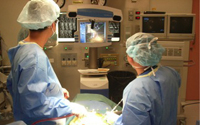
Prior to surgery, patients undergo a series of CT scans. Once the images are downloaded into the navigation system, orthopaedic surgeon would perform a calibration process that is critical for the surgical outcome. Then Orthopaedic surgeon can then perform surgeries based on a 3-D anatomical picture of the patient. Orthopaedic surgeon insert a probing instrument through a small incision in the patient, and then the probe transmits signals back to the system. The system software integrates the patient’s CT scan with data from the digital camera probe, and then displays a real-time view on-screen of exactly where the instruments are positioned - throughout the procedure.

Spine Navigation Surgery – Pros & Cons
1.      In the traditional orthopaedic surgeries, screws are placed using a freehand technique or by fluoroscopy, which uses X-rays to capture an image on a television screen of the process of screw placement. Both patients and the staffs of operating room can be exposed to radiation and must use lead clothing for protection. The spine navigation surgery employ a special camera on a computer that uses infrared light to track a surgical instrument in 3D space that can reduce the X-ray exposures.
2.      Spine navigation surgery is performed on a 3D anatomical instead of 2D that can help orthopaedic surgeon to guide their instruments for precise screw placement
3.      The matching / calibration process is critical for surgical outcomes and experienced techniques are necessary.
4.     The benefits of spine navigation surgery must be weighed against potential complications from the surgery. Potential risks and complications include: anesthesia, infection, blood loss, nerve injury, possible re-operation and continued pain. Patients should consult with their orthopaedic surgeon for further details.

Reference information: www.ispine.com.hk

It is not intended as medical advice to any specific person. If you have any need for personal advice or have any questions regarding your health, please consult your orthopedic doctors for diagnosis and treatment.

2011年2月21日星期一

Spine Navigation Surgery - minimal invasive and computer assisted surgery


Spine Navigation Surgery was introduced since year 2000 and adapted in Hong Kong for more than 5 years. Similar technology was widely used in driving, computer games (like Wii),etc. The image-based technology used in spinal surgery utilizes scans of the patient's anatomy and instruments that are tracked by the Navigation System's camera. Navigation can help orthopaedic surgeon to guide their instruments for precise screw placement and reduce X-ray exposure.

Spine navigation surgery - Applications
Orthopaedic doctor will undergo proper diagnosis and evaluation before recommendation of surgery. Generally, the spine navigation surgery is applicable for common spinal disorders and especially for surgical position that require precise screw placement. For example,
1.      Patient requires re-operation due to operation failure. 
2.      Surgical position is worn out or delicate, such as osteoporotic patients.
3.      Surgical position is located in hard-to-reach area, like neck, distorted vertebrate, pedicle of vertebral arch.

Reference information: www.ispine.com.hk

It is not intended as medical advice to any specific person. If you have any need for personal advice or have any questions regarding your health, please consult your orthopedic doctors for diagnosis and treatment.

2011年2月17日星期四

Back Pain Treatment (Hong Kong reporter)


       1.      Physiotherapy. It can be classified as active and inactive treatment.
Active – effectively strengthen the patient’s muscle through persistent specific exercise. 
Inactive – relieve pain in specific position through micro-current therapy

Misconception:
Many patients believe that reductions of physical activity can relieve their pain conditions, however, it is incorrect as physical acticity can help to strengthen your muscle and relieve the pain in long term. You are recommend to consult physiotherapy to personalize an exercise plan for you.

2.      Medication
Depends on the severity of pain, orthopaedic doctor would prescribe oral medications for pain reliever. If needed or pain persist, orthopaedic doctor may recommend for intramuscular or percutaneous injections of nerve blocks to control your back pain.

3.      Surgery
Orthopaedic doctor would recommend for orthopaedic surgery if needed, especially for patients suffering:

i.                    Medications and physiotherapy treatments cannot manipulate the back pain
ii.                  Incontinence caused by nerve compression
iii.                Progressive muscle weakness caused by nerve compression
iv.                No improvement of pain conditions after 4-6 weeks physiotherapy treatment.

Reference information: www.ispine.com.hk

It is not intended as medical advice to any specific person. If you have any need for personal advice or have any questions regarding your health, please consult your orthopaedic doctor.