顯示包含「Orthopaedic」標籤的文章。顯示所有文章

2012年4月3日星期二

Back pain - Physical therapy & Surgery

A physical therapist can apply a variety of treatments, such as heat, ice, ultrasound, electrical stimulation and muscle-release techniques, to your back muscles and soft tissues to reduce pain. As pain improves, the therapist can teach you specific exercises to increase your flexibility, strengthen your back and abdominal muscles, and improve your posture. Regular use of these techniques will help prevent pain from returning.


Injections
If other measures don't relieve your pain and if your pain radiates down your leg, your doctor may inject cortisone — an anti-inflammatory medication — into the space around your spinal cord (epidural space).
Surgery
Types of back surgery include:
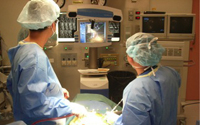
  • Spine navigation surgery. It is a new techniques that can enhance the precision in the surgical regions, reduce the surgical time, reduce radiation exposures to patients and surgeon. Increase safety and accuracy through more precise screw placement and enables minimally invasive approaches.
  • Partial removal of disk. If disk material is pressing or squeezing a nerve, your orthopaedics doctor may be able to remove just the portion of the disk that's causing the problem.
  • Partial removal of a vertebra. If your spine has developed bony growths that are pinching your spinal cord or nerves, orthopaedics surgeons can remove a small section of the offending vertebra, to open up the passage.
  • Fusion. This surgery involves joining two vertebrae to eliminate painful movement. A drawback to the procedure is that it increases the chances of arthritis developing in adjoining vertebrae.
Reference information: knowyourback.org, ispine.com.hk

It is not intended as medical advice to any specific person. If you have any need for personal advice or have any questions regarding your health, please consult your personal physician.

2012年3月28日星期三

Intervertebral Disc

The ANNULUS FIBROSUS makes up the outer part of the disc. It consists of collagen fibers containing significant amounts of water and proteoglycans. These fibers are arranged in concentric layers called LAMELLAE. The lamellae are thicker and more numerous in the anterior part of the disc.


Within each lamella, the collagen fibres are oriented obliquely about 30º to the horizontal. The orientation is reversed in each contiguous layer, resulting in a 120º change from layer to layer. This interstriation of fibers imparts great tensile strength and allows for multiplanar motion. The structure of the disc is similar to a radial automobile tire, which also has great strength and simultaneous compression and tension capabilities.

The NUCLEUS PULPOSUS is the internal substance of the disc. The inner fibers of the annulus fibrosus gradually blend with the nucleus pulposus.

The nucleus pulposus is more gelatinous than the annulus and has a higher water and proteoglycan content. The water content can be 85% in young people; in older people, the water content of the nucleus pulposus may be less than 25%. The nucleus pulposus acts to resist compression in axial loading forces.

Besides allowing for motion, the discs act as shock absorbers to prevent injury to the vertebral bodies and neurological struc-tures. However, the discs are so strong that in compression, the vertebral body will fail before the discs fail.


Reference information: ispine.com.hk

It is not intended as medical advice to any specific person. If you have any need for personal advice or have any questions regarding your health, please consult your orthopedic doctors for diagnosis and treatment.

2012年2月14日星期二

Physical therapy & Surgery - Back pain

A physical therapist can apply a variety of treatments, such as heat, ice, ultrasound, electrical stimulation and muscle-release techniques, to your back muscles and soft tissues to reduce pain. As pain improves, the therapist can teach you specific exercises to increase your flexibility, strengthen your back and abdominal muscles, and improve your posture. Regular use of these techniques will help prevent pain from returning.


Injections
If other measures don't relieve your pain and if your pain radiates down your leg, your doctor may inject cortisone — an anti-inflammatory medication — into the space around your spinal cord (epidural space).
Surgery
Types of back surgery include:
  • Spine navigation surgery. It is a new techniques that can enhance the precision in the surgical regions, reduce the surgical time, reduce radiation exposures to patients and surgeon. Increase safety and accuracy through more precise screw placement and enables minimally invasive approaches.
  • Partial removal of disk. If disk material is pressing or squeezing a nerve, your orthopaedics doctor may be able to remove just the portion of the disk that's causing the problem.
  • Partial removal of a vertebra. If your spine has developed bony growths that are pinching your spinal cord or nerves, orthopaedics surgeons can remove a small section of the offending vertebra, to open up the passage.
  • Fusion. This surgery involves joining two vertebrae to eliminate painful movement. A drawback to the procedure is that it increases the chances of arthritis developing in adjoining vertebrae.
Reference information: knowyourback.org, ispine.com.hk

It is not intended as medical advice to any specific person. If you have any need for personal advice or have any questions regarding your health, please consult your personal physician.

2011年3月26日星期六

Intervertebral Disc


The ANNULUS FIBROSUS makes up the outer part of the disc. It consists of collagen fibers containing significant amounts of water and proteoglycans. These fibers are arranged in concentric layers called LAMELLAE. The lamellae are thicker and more numerous in the anterior part of the disc.

Within each lamella, the collagen fibres are oriented obliquely about 30º to the horizontal. The orientation is reversed in each contiguous layer, resulting in a 120º change from layer to layer. This interstriation of fibers imparts great tensile strength and allows for multiplanar motion. The structure of the disc is similar to a radial automobile tire, which also has great strength and simultaneous compression and tension capabilities.

The NUCLEUS PULPOSUS is the internal substance of the disc. The inner fibers of the annulus fibrosus gradually blend with the nucleus pulposus.

The nucleus pulposus is more gelatinous than the annulus and has a higher water and proteoglycan content. The water content can be 85% in young people; in older people, the water content of the nucleus pulposus may be less than 25%. The nucleus pulposus acts to resist compression in axial loading forces.

Besides allowing for motion, the discs act as shock absorbers to prevent injury to the vertebral bodies and neurological struc-tures. However, the discs are so strong that in compression, the vertebral body will fail before the discs fail.

Reference information: www.hkoa.org
It is not intended as medical advice to any specific person. If you have any need for personal advice or have any questions regarding your health, please consult your orthopedic doctors for diagnosis and treatment.

2011年2月21日星期一

Spine Navigation Surgery - minimal invasive and computer assisted surgery


Spine Navigation Surgery was introduced since year 2000 and adapted in Hong Kong for more than 5 years. Similar technology was widely used in driving, computer games (like Wii),etc. The image-based technology used in spinal surgery utilizes scans of the patient's anatomy and instruments that are tracked by the Navigation System's camera. Navigation can help orthopaedic surgeon to guide their instruments for precise screw placement and reduce X-ray exposure.

Spine navigation surgery - Applications
Orthopaedic doctor will undergo proper diagnosis and evaluation before recommendation of surgery. Generally, the spine navigation surgery is applicable for common spinal disorders and especially for surgical position that require precise screw placement. For example,
1.      Patient requires re-operation due to operation failure. 
2.      Surgical position is worn out or delicate, such as osteoporotic patients.
3.      Surgical position is located in hard-to-reach area, like neck, distorted vertebrate, pedicle of vertebral arch.

Reference information: www.ispine.com.hk

It is not intended as medical advice to any specific person. If you have any need for personal advice or have any questions regarding your health, please consult your orthopedic doctors for diagnosis and treatment.