顯示包含「Spine Navigation Surgery」標籤的文章。顯示所有文章

2013年1月22日星期二

Spine Navigation Surgery (1)


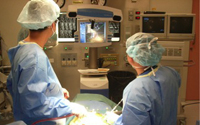
Spine Navigation Surgery - minimally invasive and computer assisted surgery

Spine Navigation Surgery was introduced since year 2000 and adapted in Hong Kong for more than 5 years. Similar technology was widely used in daily activities like driving, computer games (like Wii),etc.. The image-based technology used in spinal surgery utilizes scans of the patient's bony anatomy and instruments that are tracked by the Navigation System's camera. Navigation can help orthopaedic surgeons to guide their instruments for precise screw placement and reduce X-ray exposure.


Spine navigation surgery - Applications

Orthopaedic doctors will undergo proper diagnosis and evaluation before recommendation of surgery. Generally, spine navigation surgery is applicable for common spinal disorders requiring screw placement and especially for areas requiring high surgical precision. For example,

  1. Revision spine surgery.
  2. Patients with osteoporotic bones.
  3. High risk areas like the cervical spine or areas with severe deformities.


Reference information: www.ispine.com.hk

It is not intended as medical advice to any specific person. If you have any need for personal advice or have any questions regarding your health, please consult your personal physician.

2011年2月22日星期二

Spine Navigation Surgery - minimal invasive and computer assisted surgery


Spine Navigation Surgery – Procedures
Prior to surgery, patients undergo a series of CT scans. Once the images are downloaded into the navigation system, orthopaedic surgeon would perform a calibration process that is critical for the surgical outcome. Then Orthopaedic surgeon can then perform surgeries based on a 3-D anatomical picture of the patient. Orthopaedic surgeon insert a probing instrument through a small incision in the patient, and then the probe transmits signals back to the system. The system software integrates the patient’s CT scan with data from the digital camera probe, and then displays a real-time view on-screen of exactly where the instruments are positioned - throughout the procedure.

Spine Navigation Surgery – Pros & Cons
1.      In the traditional orthopaedic surgeries, screws are placed using a freehand technique or by fluoroscopy, which uses X-rays to capture an image on a television screen of the process of screw placement. Both patients and the staffs of operating room can be exposed to radiation and must use lead clothing for protection. The spine navigation surgery employ a special camera on a computer that uses infrared light to track a surgical instrument in 3D space that can reduce the X-ray exposures.
2.      Spine navigation surgery is performed on a 3D anatomical instead of 2D that can help orthopaedic surgeon to guide their instruments for precise screw placement
3.      The matching / calibration process is critical for surgical outcomes and experienced techniques are necessary.
4.     The benefits of spine navigation surgery must be weighed against potential complications from the surgery. Potential risks and complications include: anesthesia, infection, blood loss, nerve injury, possible re-operation and continued pain. Patients should consult with their orthopaedic surgeon for further details.

Reference information: www.ispine.com.hk

It is not intended as medical advice to any specific person. If you have any need for personal advice or have any questions regarding your health, please consult your orthopedic doctors for diagnosis and treatment.

2011年2月21日星期一

Spine Navigation Surgery - minimal invasive and computer assisted surgery


Spine Navigation Surgery was introduced since year 2000 and adapted in Hong Kong for more than 5 years. Similar technology was widely used in driving, computer games (like Wii),etc. The image-based technology used in spinal surgery utilizes scans of the patient's anatomy and instruments that are tracked by the Navigation System's camera. Navigation can help orthopaedic surgeon to guide their instruments for precise screw placement and reduce X-ray exposure.

Spine navigation surgery - Applications
Orthopaedic doctor will undergo proper diagnosis and evaluation before recommendation of surgery. Generally, the spine navigation surgery is applicable for common spinal disorders and especially for surgical position that require precise screw placement. For example,
1.      Patient requires re-operation due to operation failure. 
2.      Surgical position is worn out or delicate, such as osteoporotic patients.
3.      Surgical position is located in hard-to-reach area, like neck, distorted vertebrate, pedicle of vertebral arch.

Reference information: www.ispine.com.hk

It is not intended as medical advice to any specific person. If you have any need for personal advice or have any questions regarding your health, please consult your orthopedic doctors for diagnosis and treatment.